Attackers Are Exploiting the Time Between Automation and Review
Package installs, SaaS sessions, shared hosting, and fake meeting workflows all exposed the same defender problem. The attack path now completes before normal review and response processes catch up.

INTRODUCTION
Adversaries this week did not need defenders to miss the obvious. They needed normal workflows to move faster than review, approval, and response.
TeamPCP injected malicious code into SAP’s npm package ecosystem using a “Mini Shai-Hulud” wormable technique. Threat actors compromised PyTorch Lightning on PyPI, pushing credential-stealing payloads through a package downloaded millions of times. Cordial Spider and Snarky Spider vished their way into SaaS environments and moved quickly toward extortion. CISA confirmed active exploitation of cPanel’s authentication bypass, granting attackers root access to shared hosting infrastructure. BlueNoroff used fake Zoom meetings, ClickFix-style instructions, and fileless PowerShell against Web3 targets.
None of these attacks required a defender to make an exotic mistake.
The assumption under pressure this week is that normal workflows create enough time for security review. Package installation happens before code review. SaaS sessions can be looted before endpoint telemetry matters. Shared hosting can become collateral damage before the business remembers it owns the site. A fake meeting can become code execution before the user realizes the meeting was the payload.
If your controls depend on review happening after execution begins, what exactly are they still preventing?
If you enjoy reading our newsletter, share it!
Thanks for supporting The Monday Brief.
WEEKLY SIGNALS ANALYSIS
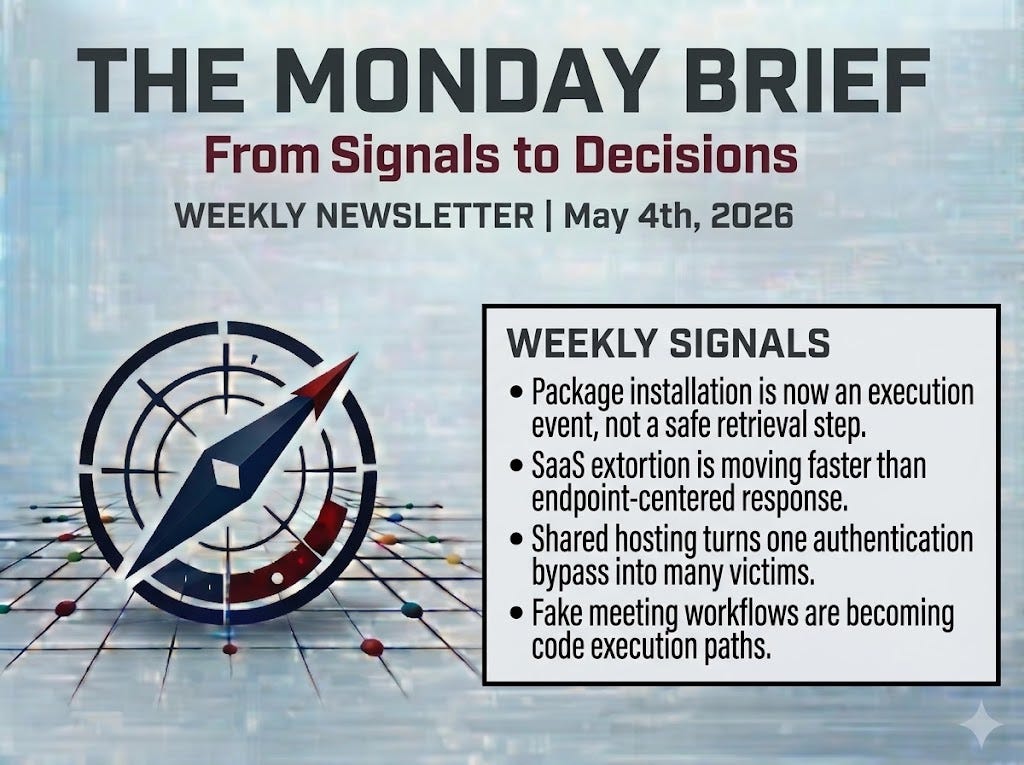
The install phase is now the attack surface, not the code review phase. TeamPCP’s wormable npm attack and the PyTorch Lightning compromise both delivered malicious payloads through trusted package registries. Audit postinstall hooks and restrict egress from build and CI/CD environments immediately.
SaaS extortion is moving faster than endpoint-centered response. Cordial Spider and Snarky Spider used phone calls, fake SSO pages, and legitimate SaaS sessions to move toward data theft and extortion. If your detection strategy depends primarily on endpoint telemetry, your response model is already behind the intrusion path.
Shared infrastructure turns one authentication bypass into many victims. The cPanel CVE-2026-41940 exploitation grants root access across every site on an affected server. Inventory externally hosted web properties and verify provider patching instead of assuming hosting risk stops at the vendor boundary.
Fake meeting workflows are becoming execution paths. BlueNoroff’s use of AI-generated Zoom lures, ClickFix-style commands, and fileless PowerShell shows that collaboration workflows now need the same threat modeling as email, identity, and endpoint controls.
THIS WEEK’S SIGNALS
Signal 1: Wormable Supply Chain Attacks Hit SAP and PyTorch Lightning Simultaneously
Why it matters: Two separate supply chain campaigns compromised widely trusted package ecosystems in the same week. TeamPCP used a wormable “Mini Shai-Hulud” technique against SAP’s Cloud Application Programming Model npm packages, while a different set of attackers pushed credential-stealing versions of PyTorch Lightning to PyPI. These are not typosquatting attacks against obscure libraries. They target packages that enterprises pull into production builds automatically.
What is being misread: Most organizations treat supply chain security as a dependency scanning problem, looking for known CVEs in packages they already use. That model assumes the package itself remains trustworthy between scans. Both of these attacks exploited the window between a legitimate package being compromised and anyone noticing. The architectural flaw is that package managers are designed to trust upstream publishers implicitly, and most CI/CD pipelines have no mechanism to detect behavioral changes in a package between versions.
Think Red (Douglas McKee): The build pipeline is the highest-leverage place to land because it already has credentials, secrets, signing paths, and permission to pull code automatically. I do not need to beat your EDR if I can get my code into a package your build system invites in on its own. With TeamPCP’s approach, one compromised SAP npm package can propagate through dependent packages and downstream builds without me targeting each victim directly. The win condition is pipeline access, not production access, because the pipeline is where production trust gets manufactured. One poisoned package turns review lag into attacker scale.
Act Blue (Ismael Valenzuela): The reality most organizations face is that their build pipelines treat package installation as a trusted operation. That assumption must change today. Pin every dependency to a known-good hash and enforce integrity verification in your package manager configuration. Set up egress filtering on build agents so that even if a postinstall script executes, it cannot reach an external command-and-control endpoint. But do not stop there. Implement behavioral monitoring on your CI/CD infrastructure. Watch for unexpected network connections, new environment variable reads, credential access, or file access patterns during builds. Require build isolation so package installation cannot reach production secrets, signing keys, or deployment tokens by default. The principle is straightforward: your build environment deserves the same zero-trust posture as your production environment, because to an attacker, they are the same thing.
Supporting sources:
Dark Reading: TeamPCP’s wormable “Mini Shai-Hulud” attack compromises SAP npm packages in cloud application ecosystem
The Hacker News: PyTorch Lightning compromised on PyPI, malicious versions push credential theft payloads
Unit 42: Analysis of npm supply chain attack evolution including wormable malware and CI/CD persistence
The Hacker News: Poisoned Ruby Gems and Go Modules exploit CI pipelines for credential theft and GitHub Actions tampering
Signal 2: Cordial Spider and Snarky Spider Move SaaS Extortion Below Endpoint Visibility
Why it matters: CrowdStrike identified two new extortion groups, Cordial Spider and Snarky Spider, both affiliated with The Com, executing rapid data theft and extortion campaigns against enterprises. They call employees, impersonate IT helpdesk staff, direct victims to fake SSO login pages, capture credentials, and move laterally through SaaS environments. The campaign moves quickly from vishing to SaaS access and data theft, reducing the value of response models that wait for endpoint evidence before escalating. They operate almost entirely within SaaS platforms, leaving minimal endpoint forensic evidence.
What is being misread: Security teams focus detection and response on endpoint telemetry and network anomalies. These groups bypass both by operating within legitimate SaaS sessions. The broken assumption is that SaaS environments generate enough logging fidelity and that SOC teams monitor those logs with the same urgency as endpoint alerts. Most SaaS audit logs are reviewed retroactively during incident response, not in real time. The attackers know this and exploit the detection gap between “credential used” and “data exfiltrated” because both look like normal user activity.
Think Red (Douglas McKee): A valid SaaS session is better than malware because it already looks like work. I can use a phone call and a fake SSO page to get the thing your environment trusts most, an authenticated user operating inside approved cloud services. From there, the value is in speed and legitimacy. I do not need persistence on an endpoint if I can collect sensitive files, create pressure, and move to extortion before anyone treats the SaaS logs as the primary crime scene. The perimeter is not where I enter. It is where your visibility stops.
Act Blue (Ismael Valenzuela): Most SOCs have invested heavily in endpoint detection but still treat SaaS telemetry as a secondary data source. That imbalance is exactly what Cordial Spider and Snarky Spider exploit. Enable real-time alerting on anomalous SaaS behaviors looking for impossible travel on session tokens, bulk file downloads from SharePoint or Google Drive, new OAuth application grants, and mailbox or file-sharing rule changes after helpdesk interaction. Require out-of-band verification for any helpdesk-initiated credential reset, MFA enrollment change, or SSO recovery flow. Tie SaaS access to device posture, session risk, and conditional access controls so a valid password or session token is not enough to move freely. Pre-authorize rapid session revocation and token invalidation for high-confidence SaaS abuse. If your adversary lives in SaaS, your containment plan has to live there too.
Supporting sources:
The Hacker News: Detailed analysis of vishing and SSO abuse techniques used by Com-affiliated extortion groups
Signal 3: cPanel Authentication Bypass Under Active Exploitation Grants Root Access to Shared Hosting
Why it matters: CISA added CVE-2026-41940 to the Known Exploited Vulnerabilities catalog after hosting providers confirmed active, ongoing attacks exploiting a cPanel authentication bypass. The flaw allows attackers to bypass login entirely and gain root access. cPanel manages an enormous share of the global shared hosting market, meaning a single exploitation can compromise every website on an affected server. For organizations that rely on shared hosting for marketing sites, customer portals, or partner-facing applications, this is not a theoretical risk.
What is being misread: Enterprise security teams often treat shared hosting as someone else’s problem because it sits outside the corporate perimeter. The architectural blind spot is that many organizations have business-critical web properties, customer data collection forms, or partner portals running on shared hosting managed by a third party. When that third party’s control panel is compromised at the root level, every tenant is exposed. The mental model of “we only care about infrastructure we control” fails when the blast radius of a single vulnerability spans thousands of tenants.
Think Red (Douglas McKee): Shared hosting is attractive because I get scale without precision. One cPanel authentication bypass gives me root on a server that may host dozens or hundreds of unrelated sites, including forgotten landing pages, partner portals, and old campaign microsites. I do not need your main environment to be weak if your brand still depends on infrastructure someone else manages. From that position, credential harvesting, traffic redirection, and watering-hole access all become low-cost options. You are not the target I chose. You are the blast radius I inherited.
Act Blue (Ismael Valenzuela): Shared hosting creates a trust dependency that most enterprise risk registers undercount. Start by inventorying every web property your organization operates outside its primary infrastructure, including marketing microsites, event pages, customer forms, and partner portals. Confirm with each hosting provider that CVE-2026-41940 has been patched, but do not treat provider confirmation as validation. Independently scan for exposed cPanel and WHM interfaces, review DNS records for forgotten properties, and monitor for unexpected redirects, injected JavaScript, or new administrative sessions. Any site that collects user data or links to internal systems should move to infrastructure you control or at minimum to isolated hosting. Every web property bearing your brand is part of your attack surface, regardless of who manages the server beneath it.
Supporting sources:
CyberScoop: CISA adds cPanel CVE-2026-41940 to KEV list after hosting providers confirm active exploitation
Hackread: Technical analysis of cPanel authentication bypass enabling root access
Rapid Risk Radar: CVE-2026-41940
Signal 4: BlueNoroff Turns Fake Zoom Meetings Into Fileless Web3 Intrusions
Why it matters: BlueNoroff, the financially motivated Lazarus subgroup tied to North Korea, is now using AI-generated Zoom lures, ClickFix-style instructions, and fileless PowerShell against Web3 targets. Arctic Wolf’s reporting describes a campaign against a North American Web3 firm where the victim was pushed through a fake meeting workflow and instructed to run commands that executed malware without relying on a traditional file-based payload. The tactic matters because it compresses social engineering, user-assisted execution, and stealthy post-compromise access into a workflow that looks like a normal business meeting.
What is being misread: This is not just another phishing campaign with better visuals. The misread is treating fake Zoom lures, ClickFix commands, and fileless PowerShell as separate techniques. The real shift is that DPRK financial operators are combining AI-assisted impersonation, collaboration-platform trust, and living-off-the-land execution into one continuous intrusion path. BlueNoroff has been abusing fake meetings, fake job interviews, developer workflows, and Web3 trust relationships for years; this campaign shows the same playbook getting faster and more convincing.
Think Red (Douglas McKee): The meeting is the payload delivery system. A fake Zoom flow gives me context, urgency, and a reason for the victim to follow instructions that would look absurd in an email. ClickFix is powerful because it turns the user into the execution path, and fileless PowerShell keeps the first stage below the level many teams will investigate quickly. I am not trying to compromise the blockchain. I am trying to compromise the workstation where keys, tokens, wallet access, and deal context converge. In Web3, one trusted conversation can be enough financial access to matter.
Act Blue (Ismael Valenzuela): This is where experience matters. Social engineering is no longer limited to email, and collaboration workflows now need the same defensive attention as identity and endpoint controls. Immediately brief high-risk teams in Web3, finance, legal, engineering, and executive support on fake meeting workflows that ask users to paste commands into Run, Terminal, or PowerShell. Block or alert on PowerShell execution chains launched from browsers, conferencing applications, archive utilities, and user profile paths. But do not stop at user training. Training will not hold when the lure includes realistic video, familiar meeting language, and time pressure. Restrict PowerShell to constrained language mode where possible, enforce script block logging, monitor for encoded commands and remote script retrieval, and require managed-device posture before accessing wallets, signing systems, cloud consoles, or sensitive SaaS repositories. Most importantly, separate meeting participation from privileged work. If a device can approve financial movement or access production secrets, it should not also be a lightly monitored collaboration endpoint. Real detection coverage starts where the attacker asks the user to become part of the execution chain.
Supporting sources:
Infosecurity Magazine: Coverage of DPRK hackers using deepfake video calls and ClickFix techniques to target cryptocurrency and Web3 firms
Huntress: Prior BlueNoroff Web3 intrusion showing fake meeting infrastructure and collaboration-workflow abuse
MEME OF THE WEEK
The attacker did not bypass the workflow. They just got there before security did.

ROLE-BASED TAKEAWAYS
Executive / CISO / Board Level
Supply chain exposure is a board-level risk this week. The simultaneous compromise of SAP npm packages and PyTorch Lightning demonstrates that trusted software registries are active attack surfaces. Ask engineering leadership for an inventory of automated dependency pulls and the controls around them. If the answer is “we trust the package manager,” that is the gap.
SaaS and collaboration attacks are moving below traditional response visibility. Cordial Spider, Snarky Spider, and BlueNoroff all show attackers abusing legitimate user workflows instead of endpoint exploitation. Require detection and containment plans for SaaS sessions, helpdesk-driven identity changes, and meeting workflows that lead to command execution.
Audit your organization’s externally managed attack surface. The cPanel exploitation means forgotten marketing sites and partner portals on shared hosting are potential brand and data risks. Commission an inventory of all web properties bearing your name, regardless of who hosts them.
Enterprise Architect
Design Principle Impact: Build environments and collaboration workflows must enforce the same zero-trust posture as production. The SAP and PyTorch compromises prove that “install” is an execution event, while BlueNoroff proves that “join meeting and run this fix” can become one too.
New Constraint/Dependency: SaaS-native and collaboration-native detection are now hard requirements, not enhancements. If your architecture relies on endpoint telemetry while employees operate in SaaS apps, helpdesk workflows, shared hosting platforms, and conferencing tools, you have structural blind spots attackers are already targeting.
Security Operations
Implementation Watch Item: Monitor for unexpected version bumps in pinned npm and PyPI packages across all build environments, and alert on PowerShell executions launched from browsers, conferencing apps, archive utilities, or user profile paths.
Common Failure Mode: Teams treat each signal as a separate control problem. Build pipelines, SaaS logs, shared hosting, and conferencing workflows all generate telemetry, but none of it helps if it is reviewed only after the incident has already moved to data theft or persistence.
Monitoring Patterns: Watch for helpdesk tickets requesting MFA resets or credential changes where the requester called in. Correlate with SaaS login events soon after the reset. Track cPanel login anomalies and unexpected WHM session creation on any managed hosting infrastructure. For BlueNoroff-style activity, monitor encoded PowerShell, remote script retrieval, suspicious child processes spawned from meeting or browser contexts, and user execution following fake troubleshooting prompts.
Signal vs Noise Guidance: A single failed SSO login from an unusual location is noise. A successful SSO login followed by bulk SharePoint or Google Drive downloads within the same session is signal. A user launching PowerShell is not always malicious. A browser or conferencing workflow leading to encoded PowerShell, remote script retrieval, or ClickFix-style command execution is high-confidence signal.
Take the adversary by surprise: Build tripwires into the workflows attackers expect to move quickly. Seed monitored helpdesk reset requests, fake package update approvals, and fake Web3 meeting escalations that look operationally normal but route into a security-owned queue. Alert on any follow-on SaaS access, package installation, PowerShell execution, or privilege change tied to those decoy workflows. The goal is to detect the attacker when they abuse process velocity, not after they reach the data.
See you next Monday!
The Monday Brief is produced by Douglas McKee and Ismael Valenzuela. The opinions expressed are our own and do not reflect those of our employers.