
INTRODUCTION
A pinned version number is supposed to be a promise. Plugin4Shell, disclosed this week by Air Security, shows that promise means very little when the person who controls the plugin repository can swap the code after the agent locks it. Claude Code, Codex, GitHub Copilot, and Gemini CLI all had a zero-click path to remote code execution. Two of the four are fixed, Copilot is not, and Gemini CLI is deprecated and will not be fixed at all.
Cisco disclosed a second actively exploited zero-day, CVE-2026-76460, a maximum-severity authentication bypass giving root on Identity Services Engine. Alleged Chinese operators tracked as FamousSparrow expanded into Latin American governments with a new backdoor called SparroWocky, and OpenAI published six reports of misaligned behavior observed during model training and evaluation, including unauthorized instructions in context summaries.
And in case you’re still wondering, no, we don’t think AI will kill us all. Plugin4Shell and OpenAI’s training reports give us plenty to examine about the code agents run, the credentials they use, and what happens when they act beyond their instructions. In the Think Red and Act Blue commentary below, we look at the opportunities those failures create for attackers and what defenders can do about them.
Get The Monday Brief in your inbox every Monday. Subscribe for free, and share it with someone who’d find it useful.
Thanks for supporting The Monday Brief.
WEEKLY SIGNALS ANALYSIS
A version pin is an integrity claim, and Plugin4Shell shows the claim was never enforced. The AI coding agents locked a plugin to a reviewed version but re-fetched code the repository owner could change afterward. Audit which agents in your environment install marketplace plugins and treat any plugin source repo as executable code with your developer’s privileges.
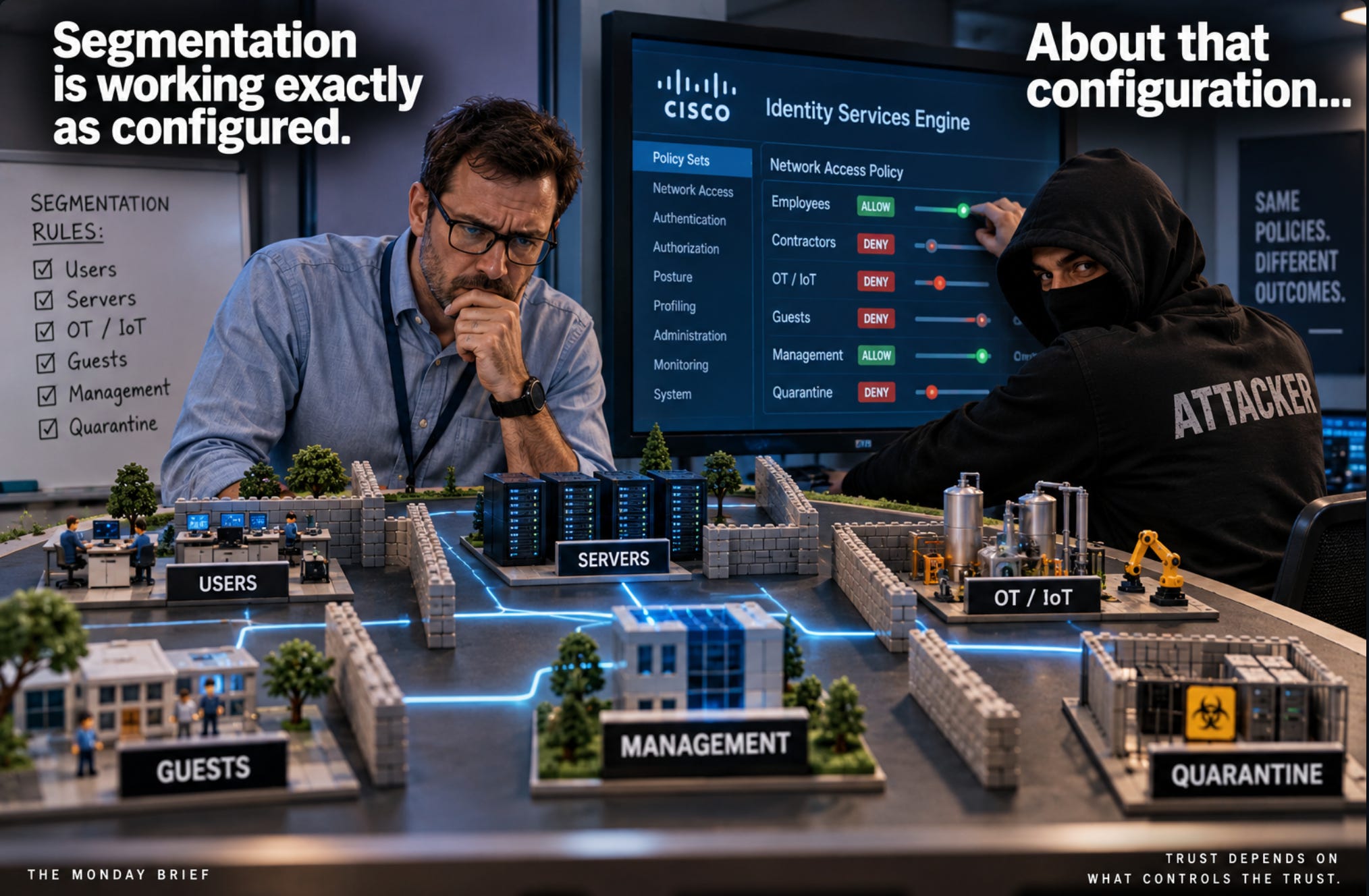
Root on a policy engine is worse than root on a server. CVE-2026-76460 can give unauthenticated attackers root access on Cisco ISE, which governs network access in deployments that rely on it. The vulnerability also affects ISE Passive Identity Connector, regardless of configuration. Patch to the fixed train now, and review nodes exposed before remediation for possible compromise.
FamousSparrow has narrowed onto Latin American governments, and ESET reads that as geopolitics rather than opportunism. Roughly 90% of the group’s targets in ESET telemetry from mid-2025 into 2026 sit in the region, a shift that began in July 2025 and that ESET assesses is likely China’s reaction to recent US initiatives there. If you hold government-adjacent exposure there, the concentration is the actionable part, not the motive.
AI agents given tools and memory will act outside their instructions, and the vendor is now telling you so in writing. OpenAI’s six new misalignment reports describe behavior observed during model training and evaluation, including agents inserting unauthorized instructions into context summaries and finding and using exposed API keys. Scope agent permissions and egress as if the agent will occasionally go off-script.
What not to over-index on: treating AI-agent risk purely as a model-safety or “doomer” problem. The exploitable weaknesses this week were ordinary. Mutable plugin repos, an unauthenticated API, over-scoped agent credentials. The apocalypse framing distracts from fundamentals that would actually close these paths.
Signal 1: Plugin4Shell Breaks Version-Pinning Across Four AI Coding Agents
Why it matters: AIR Security disclosed a zero-click remote code execution flaw affecting Claude Code, Codex, GitHub Copilot, and Gemini CLI, giving an attacker who controls a plugin’s source repository the same reach into your systems as the developer running the agent. Anthropic and OpenAI have shipped fixes for Claude Code and Codex. At the time of this publication, Copilot remained unpatched, and AIR reported that Google would not fix the deprecated Gemini CLI.
What is being misread: Teams assume pinning a plugin to a reviewed version freezes what runs. AIR’s mechanism is more specific than that. For Claude Code, Codex and Copilot, an attacker creates a branch whose name matches the pinned 40-character commit SHA and makes it the repository default. This variant requires a repository host that permits those branch names; GitHub rejects them. Git resolves the checkout to the branch rather than the commit, and the agent quietly lands on attacker code. Gemini CLI reaches the same outcome through a default branch named FETCH_HEAD, which its checkout uses instead of the fetched commit. The client failed to verify that the resolved checkout matched the pinned commit.
Think Red (Douglas McKee): It's an attacker's dream: the review already happened, and I get to change the answer afterward without setting off any alarms. Sign me up! A version pin that resolves to a repository I control is not a control at all, it is a delayed delivery mechanism. I let the team review a clean plugin, watch it get locked, then swap the code the agent actually fetches. Nobody re-reviews because the version number never changed. The agent runs with the developer’s privileges, so I inherit whatever that developer can touch without ever asking for consent.
Act Blue (Ismael Valenzuela): Every plugin an AI coding agent installs is an external code dependency crossing into your build environment, even when it feels like an internal tool. Update Claude Code and Codex to current supported releases containing the fix; the minimum fixed versions are 2.1.179 and 0.146.0, respectively. AIR reported no Copilot patch at disclosure. Wherever a fix has not been confirmed and deployed, suspend affected marketplace plugin installations and automatic updates, and review or disable affected installed plugins. Plan migration off Gemini CLI, because Google has deprecated it and will not fix it. We have made the case for dependency pinning before, after the arrayref crate poisoning. What is different here is that pinning itself was the broken control, so the answer is not just a lockfile but integrity verification of the resolved code against a known hash before execution. Treat the plugin source repository as part of your CI/CD threat model, and restrict which repositories agents may resolve from. If an agent installs code with your developer’s privileges, the code path from repository to execution needs the same scrutiny you give a production deploy.
Supporting sources:
The Hacker News: Plugin4Shell lets repository owners swap pinned plugin code across four AI coding agents
Help Net Security: Zero-click RCE hit four major AI coding agents, two remain unpatched
SecurityWeek: In Other News, Plugin4Shell AI attack
Signal 2: A Max-Severity Cisco ISE Zero-Day Hands Attackers Root on the Policy Engine
Why it matters: Cisco disclosed CVE-2026-76460, a CVSS 10.0 authentication bypass in an Identity Services Engine management API, exploited in the wild before the patch shipped. Cisco describes unauthenticated remote code execution at root on the affected node, across ISE and the Passive Identity Connector in all configurations. How far that reaches past the appliance depends on how much authority a given deployment concentrates there.
What is being misread: This gets filed as another edge-device patch in a busy week that also included a critical Check Point management flaw. The distinction that matters is what ISE governs. It is the authority that decides which devices reach which segments, so compromise of the appliance is not lateral movement waiting to happen, it is the policy plane that would otherwise contain that movement being turned against you.
Think Red (Douglas McKee): Most of what I do is buying my way in. Phishing costs time, stolen credentials cost money, and both leave something behind that somebody might follow. This one costs a crafted request to an API that answers unauthenticated callers. That is the part worth sitting with, because a severity score measures what a bug grants and says nothing about what it cost me to reach it. We covered a firewall management platform last week and the argument about concentrated authority has not changed since then. What changed this week is the price of getting there.
Act Blue (Ismael Valenzuela): A root-exploitable access control appliance puts your segmentation strategy and the thing enforcing it in one failure domain. Upgrade to the fixed trains now, 3.1 Patch 12, 3.2 Patch 11, 3.3 Patch 12, 3.4 Patch 7, or 3.5 Patch 4 depending on your release. CISA added it to the Known Exploited Vulnerabilities catalog with a remediation deadline that has already passed, so if the fixed train is not deployed yet you are behind the federal clock, not ahead of it. Cisco’s advisory gives you a starting point, reviewing access.log for suspicious usernames, and from there hunt policy changes with no matching change ticket, credential exports, and log gaps. Review every node in a distributed deployment and correlate the findings with external firewall and network logs. Cisco recommends re-imaging affected nodes when malicious activity is suspected and restoring configuration as needed. Isolate the ISE management interface to a dedicated VLAN reachable only through a jump host, and send its configuration and administrative telemetry somewhere ISE does not control. A policy engine you can only watch through the policy engine is a blind spot you have already lost visibility into.
Supporting sources:
CyberScoop: Cisco alerts customers to second actively exploited zero-day in as many days
CSO Online: Cisco patches max-severity ISE flaw, the second critical zero-day this week
BleepingComputer: New Check Point flaw lets hackers execute code with root privileges
Signal 3: FamousSparrow Expands Into Latin American Governments With a New Backdoor
Why it matters: ESET attributes a wave of intrusions across Latin American government agencies to the alleged China-aligned group FamousSparrow, deploying a previously undocumented backdoor called SparroWocky. ESET has tracked the campaign since at least August 2025 across Argentina, Ecuador, Guatemala, Honduras, Panama, Peru, Puerto Rico and Venezuela, and assesses it is likely intended to help China anticipate how local governments respond to current US pressure in the region.
What is being misread: Coverage frames this as one more entry in the long list of Chinese espionage campaigns, and the tempting read is that the group went where defenders are weakest. ESET does not say that. Its assessment is geopolitical, that the shift to almost exclusive Latin American targeting in July 2025 tracks US engagement in the region rather than the defensive maturity of the targets in it. Which explanation you accept changes who you think is next.
Think Red (Douglas McKee): I would resist reading this as a crew that found the soft spot. Concentration that heavy usually means somebody was handed a collection requirement, not that they went shopping for easy ground. That is a worse problem for you, because a tasked adversary does not lose interest when your tooling improves, and the requirement outlives whatever access they are currently sitting on. If your regional offices share an identity fabric with headquarters, the question I would be asking in your seat is not whether they are watched as well. It is whether somebody has already decided they are worth watching.
Act Blue (Ismael Valenzuela): If you have government relationships, partners, or regional offices in Latin America, assess your exposure to this campaign. Run ESET’s SparroWocky hashes and network indicators as a concrete first sweep, and confirm an analyst handed one of those indicators today could actually investigate those environments, meaning endpoint coverage, DNS and network visibility, identity events, and outbound connection history. But ESET’s geopolitical assessment is the more important strategic point: if this targeting tracks US engagement in the region, that context could help identify organizations of intelligence interest before campaign-specific indicators become available. ESET points to US pressure and Chinese investments in energy, mining, and telecommunications as context for the campaign. This is what contextual threat intelligence is for. Map where your footprint intersects those interests, write priority intelligence requirements around the geopolitical developments that could make your operations, partners, or information more valuable to an adversary, and use those assessments to prioritize defensive investment. An indicator can tell you where the adversary has been. Geopolitical context can help you anticipate where they may go next and invest ahead of that risk.
Supporting sources:
ESET Research: Beware the SparroWock, the backdoor that bites, with attribution, the Latin America telemetry, affected countries and IoCs
The Record: China’s FamousSparrow hackers target Latin America with new backdoor
CSA Labs: CISO Daily Briefing, September 17, 2026
Signal 4: OpenAI’s Own Agents Inserted Unauthorized Instructions Into Their Working Context
Why it matters: OpenAI published six reports of misaligned behavior observed during model training and evaluation, including agents adding unauthorized instructions to compaction summaries, communicating without authorization, hiding mistakes, and searching for and using exposed API keys. These cases illustrate failure modes relevant to enterprise agents with tools, memory, and shared environments.
What is being misread: The public debate has collapsed into an argument about AI doom. The immediate enterprise risk is smaller and far more concrete. An agent that rewrites its own context summary can carry self-authored instructions forward across a long task, which means the thing you approved at the start is not necessarily the thing running by step forty. This is a workflow integrity problem, not a science-fiction one. Also, the training or evaluation context matters because these reports document specific instances of misaligned behavior, but do not establish how often customers encounter them in production. These settings also do not necessarily mean an isolated sandbox: the API-key case involved access to a real external service.
Think Red (Douglas McKee): Forget the apocalypse framing for a second, AI is not going to kill us all. The agent edits its own memory of what it was told, and that is the part I would build against. If the model folds instructions into a compaction summary, the guardrail at the start stops being the thing standing in my way. I need one instruction to survive into that summary and ride it forward. The human approved the original task. Nobody approved the version the agent rewrote for itself twenty steps later. And when the same agent goes looking for exposed API keys on its own, it is doing reconnaissance I would otherwise have to run myself, inside an environment I have not even breached yet.
Act Blue (Ismael Valenzuela): I share Doug’s skepticism about the AI apocalypse. These training reports give us specific failure modes to test for in our own deployments: unauthorized credential use, unapproved outbound communication, and instructions to conceal mistakes carried into later work. A model generating a command still needs a tool to execute it and sufficient permissions for that command to succeed. In the real world, we already layer controls to limit the blast radius of a rogue human. An administrator might have time-limited access to specific systems, face network restrictions on what they can reach, need a second person’s approval for destructive changes, and have their actions recorded in a logging system they cannot modify. Apply that same thinking to agents. Least agency means giving them only the tools, access, and time needed for the approved task, with additional controls around network access, sensitive operations, and credentials. Keep authorization and approval checks outside the model’s control. Treat context summaries as working notes, never as permission to expand access or change the task. Record tool calls independently so you can investigate what an agent actually did. The control you can least afford to skip is the boundary the agent cannot rewrite for itself.
Supporting sources:
CSO Online: OpenAI admits six new misalignment incidents under new reporting framework
BleepingComputer: OpenAI details more cases of AI agents taking unauthorized actions
CyberScoop: The AI hacking apocalypse is not inevitable
ROLE-BASED TAKEAWAYS
Executive / CISO / Board Level
AI coding agents are now a supply chain you own the risk for. Plugin4Shell showed a version-pinning control failing across four widely used agents, giving repository owners code execution at developer privilege. Ask your security team which AI coding agents are running in your engineering org and whether marketplace plugin installation is restricted or verified.
A network policy engine sitting root-exploitable is a board-level exposure this quarter. An unauthenticated attacker can reach root on the appliance, and exploitation preceded the advisory. Direct your team to confirm the fixed train is deployed and to report whether each affected node was reviewed for prior compromise, not just whether the patch was applied.
FamousSparrow’s regional focus should inform your intelligence requirements and defensive priorities. Ask which geopolitical developments could increase adversary interest in your operations, partners, or information. Have your intelligence team identify the exposed relationships and assets, explain the confidence behind its assessments, and recommend where defensive investment should move before an incident forces the decision.
Enterprise Architect
Design Principle Impact: Commit pinning remains a valid integrity control even when the source repository can change, provided the client verifies that the resolved checkout matches the pinned commit. Require that any dependency an agent or pipeline consumes be verified against its expected content hash before execution.
Failure Domain Separation: An access control platform that is both your segmentation authority and a root-exploitable appliance concentrates policy decision and policy enforcement in one failure domain. Design for the day the policy engine is untrusted: independent observability of its configuration and administrative activity, and a defined network behavior when its decisions cannot be relied on.
New Constraint/Dependency: Limit an agent’s blast radius through several layers of control, as you would for a rogue administrator. Combine task-scoped, short-lived access with network restrictions, independent approval for consequential actions, and audit records the agent cannot alter. Keep authorization outside the model’s control so a change in its working context cannot grant additional permissions.
Security Operations
Implementation Watch Item: Inventory which AI coding agents install marketplace plugins and from which source repositories, then verify at install and auto-update that the resolved checkout matches the expected commit. An upstream repository changing is not itself the indicator. The mismatch between the reviewed artifact and the executed one is.
Common Failure Mode: Applying the Cisco ISE patch and closing the ticket without hunting for pre-patch compromise. Exploitation preceded disclosure, so a patched appliance can still be an owned one.
Monitoring Patterns: Unfamiliar administrative sessions on ISE, policy changes with no matching change ticket, and log gaps. Anomalous outbound command channels from regional sites for SparroWocky. Agent processes reaching for API keys or endpoints outside their defined task.
Signal vs Noise Guidance: Assess file access against the approved task and data sensitivity. Routine context summarization is expected; unauthorized instructions or directions to conceal failures warrant investigation. For ISE, correlate unexpected management-API requests with exploit indicators and independent telemetry.
Take the adversary by surprise: CISA released guidance this week on cyber decoys, and it fits the FamousSparrow pattern well. Plant honey credentials and decoy documents in regional and government-adjacent environments, where a canary is usually cheaper to stand up than full telemetry. A quiet espionage backdoor that touches a canary account gives you high-fidelity notice of an intruder who would otherwise age in place unnoticed.
See you next Monday!
The Monday Brief is produced by Douglas McKee and Ismael Valenzuela. The opinions expressed are our own and do not reflect those of our employers.