Six Zero-Days, One Pattern: Attackers Are Buying the Steering Wheel
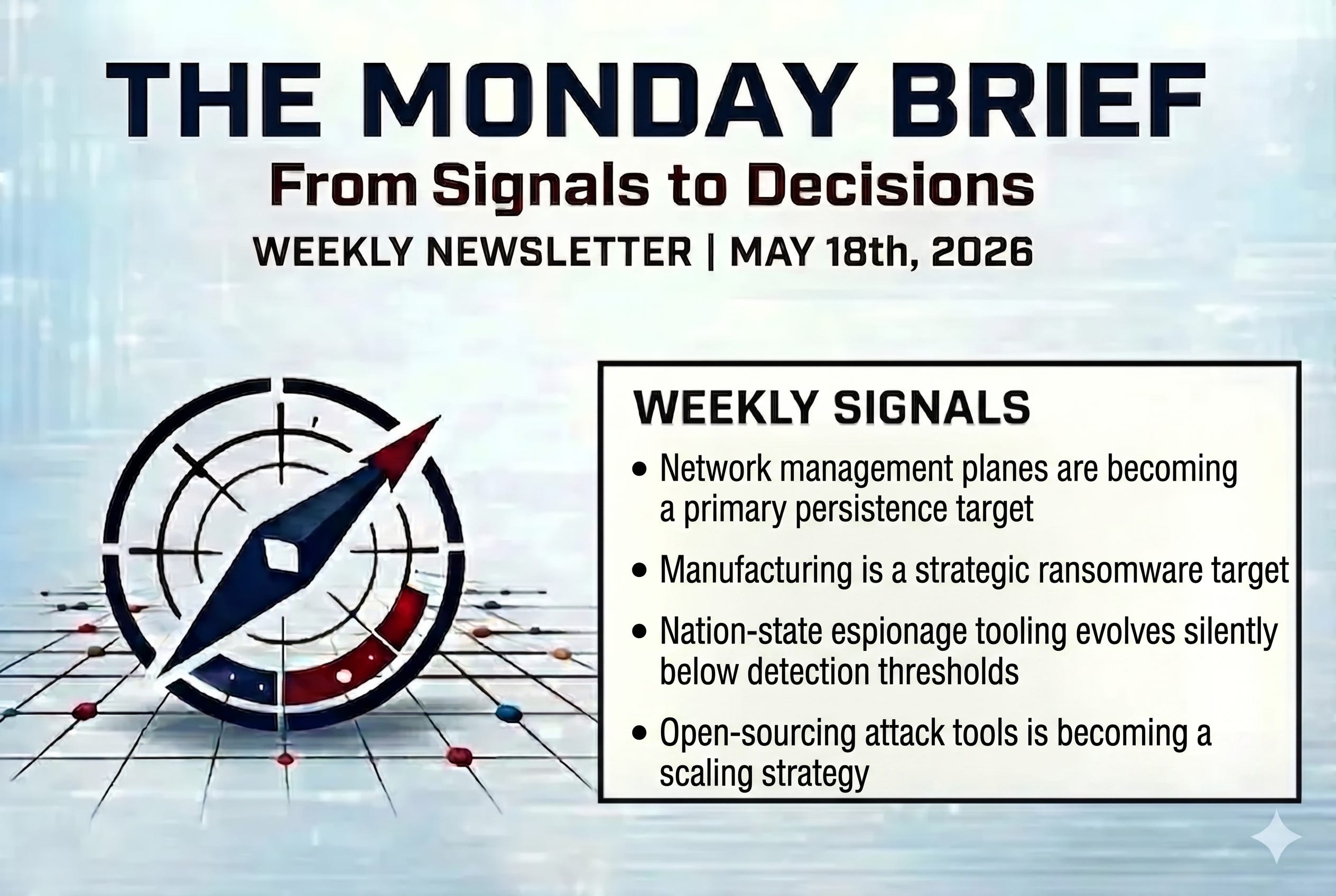
Six Cisco SD-WAN zero-days this year, 8TB out of Foxconn, a modular Russian botnet, and a worm with bounties — all targeting the systems that decide how things connect.

INTRODUCTION
Cisco disclosed the sixth exploited SD-WAN zero-day of 2026, with UAT-8616 tied to the latest campaign abusing the vulnerability to bypass authentication and gain administrative control of network controllers. Nitrogen ransomware hit Foxconn’s North American factories and claimed 8 terabytes of exfiltrated data spanning Apple and other top-tier customers. Microsoft published a full architectural teardown of Secret Blizzard’s Kazuar botnet, revealing a modular espionage platform that has been quietly evolving for years. TeamPCP released the source code for the Shai-Hulud supply chain worm and began offering bounties to anyone who weaponizes it further.
None of these required novel exploitation techniques or cutting-edge tooling.
The common thread is control without noise. Network controllers define the paths. Manufacturing partners hold the data and the downtime pressure. Modular espionage platforms keep changing shape beneath static detections. Public supply chain worm code turns one campaign into a reusable playbook. This week’s signals are less about who got in first and more about what attackers can quietly steer once they are positioned.
What would your security posture look like if you treated every management interface as adversary-accessible by default?
If you enjoy reading our newsletter, share it!
Thanks for supporting The Monday Brief.
WEEKLY SIGNALS ANALYSIS
Network management planes are now the primary persistence target, not a secondary concern. Cisco has now disclosed six exploited SD-WAN zero-days in 2026, with UAT-8616 tied to the latest campaign. If your SD-WAN controller is reachable from the internet or from a compromised segment, treat it as compromised until proven otherwise. Audit all management plane exposure this week.
Manufacturing is now a strategic ransomware target because downtime tolerance is near zero. Nitrogen’s attack on Foxconn demonstrates that gangs select victims based on operational pressure, not just data value. If your organization depends on a manufacturing partner, validate their incident response capabilities as part of your third-party risk program.
Nation-state espionage tooling evolves silently below detection thresholds for years. Microsoft’s Kazuar teardown reveals a platform that has been under continuous development, adding modular plugins for credential theft, file exfiltration, and lateral movement. Detection signatures written against last year’s variant are already stale.
Open-sourcing attack tools is now a recruitment and scaling strategy. TeamPCP released the Shai-Hulud worm source code with monetary incentives. This converts a single campaign into a community-driven threat, multiplying the number of operators and variants defenders must track.
What not to over-index on: Perimeter patching alone as your SD-WAN defense posture. The patch for CVE-2026-20182 matters, but UAT-8616 has demonstrated a pattern of burning through Cisco zero-days sequentially. Patching one flaw while leaving the management plane internet-exposed does not change the underlying exposure.
THIS WEEK’S SIGNALS
Signal 1: Cisco SD-WAN’s Sixth Zero-Day in 2026 Signals a Sustained Campaign Against Network Control Planes
Why it matters: CVE-2026-20182 is a CVSS 10.0 authentication bypass in the Cisco Catalyst SD-WAN Controller that grants unauthenticated remote attackers full administrative access. CISA has added it to the KEV catalog with a Sunday remediation deadline for federal agencies. The threat actor UAT-8616, linked to earlier Cisco firewall and SD-WAN compromises, is exploiting it in targeted attacks. This is not an isolated vulnerability. It is the sixth exploited Cisco SD-WAN zero-day this year, which makes it an ongoing campaign.
What is being misread: Most organizations treat each Cisco advisory as an independent patch event. The broken assumption is that SD-WAN controllers sit behind enough layers of network segmentation that authentication bypasses are difficult to reach. In practice, many SD-WAN management planes are reachable from segments that were never intended to be trust boundaries, and the controller’s administrative interface was designed with the assumption that only authenticated, authorized administrators would interact with it. UAT-8616 has demonstrated repeatedly that this assumption is wrong.
Think Red (Douglas McKee): The ROI calculation is simple. I invest in one product family because your organization re-deploys the same architecture after every patch. You fix CVE-2026-20182 by Sunday, and I have already cataloged the next variant. Your SD-WAN controller is the single point that defines every tunnel, every route, every policy. When I own it, I own the topology. I do not need malware on endpoints. I redirect traffic, intercept sessions, and provision myself a persistent management account that survives your next firmware update. Your SOC watches endpoint telemetry. I live in the network plane above it.
Act Blue (Ismael Valenzuela): Six zero-days in one product family in five months is not a patching problem. It is an architectural exposure. Patch CVE-2026-20182 immediately, but recognize that the patch only addresses this week’s entry point. Restrict management plane access to a dedicated, out-of-band network segment with explicit allow-lists. Monitor for new administrative accounts, configuration changes, and API calls to the SD-WAN controller using syslog forwarding to a SIEM that the controller itself cannot reach. But do not stop there. Implement network-layer anomaly detection for unexpected tunnel creation or route redistribution. If UAT-8616 has been inside your environment through a prior zero-day, the current patch does nothing to remove existing persistence. Run a threat hunt specifically targeting indicators from the earlier five CVEs in this series. The principle is straightforward: when the adversary’s campaign outlasts your patch cycle, your defense must shift from reactive remediation to continuous architectural constraint.
Supporting sources:
Rapid 7 : CVE-2026-20182: Critical authentication bypass in Cisco Catalyst SD-WAN Controller (FIXED)
SecurityWeek: Sixth exploited Cisco SD-WAN zero-day in 2026, attributed to UAT-8616
Dark Reading: Second CVSS 10.0 in Cisco’s network control system exploited this year
Rapid Risk Radar: CVE-2026-20182
Signal 2: Nitrogen Ransomware Shows Why Manufacturing Downtime Is Now the Target
Why it matters: The Nitrogen ransomware group attacked Foxconn’s North American factories and claims to have exfiltrated 8 terabytes of data spanning more than 11 million files belonging to the company’s top customers, including Apple. This attack is part of a broader pattern, with over 600 ransomware attacks targeting manufacturers in 2026 alone. Foxconn’s role as a critical supplier to the world’s largest technology companies means this breach radiates outward into every company in its customer portfolio.
What is being misread: Coverage frames this as another manufacturing breach. The deeper problem is architectural. Manufacturing environments are designed around availability, with flat network segments connecting OT and IT systems, and with business data (customer IP, product designs, logistics) co-resident alongside production control systems. Ransomware operators have learned that this design philosophy means a single intrusion can simultaneously threaten production continuity and expose customer data, creating dual leverage that most organizations cannot resist.
Think Red (Douglas McKee): I pick targets that depend on uptime, because uptime guarantees payment. Foxconn cannot tolerate a week of idle assembly lines. Neither can the customers whose data I now hold. I exfiltrate before I encrypt because the data is the second lever. Apple’s product roadmaps, component specifications, logistics schedules. Every customer in that 8 terabytes becomes a secondary pressure point. The factory restarts eventually, but the data conversation never ends. Your third-party risk assessment asked Foxconn to fill out a questionnaire. I asked their network to show me everything.
Act Blue (Ismael Valenzuela): Manufacturing environments were built for throughput, not segmentation. That design choice is the vulnerability. If your organization depends on a contract manufacturer, request evidence of actual network segmentation between IT and OT environments, not just a compliance attestation. Validate that customer intellectual property is stored in encrypted, access-controlled repositories separate from production networks. But do not stop there. Establish contractual incident notification timelines that match your own response SLAs, and conduct tabletop exercises that include your critical manufacturing partners as participants. Monitor for your own data appearing in threat actor leak sites by integrating dark web monitoring for customer file names, project codes, and internal identifiers. The lesson from Foxconn is that your supply chain partner’s flat network is your attack surface, and no questionnaire measures that.
Supporting sources:
CyberScoop: Nitrogen claimed responsibility, 8TB of data spanning top customers
Dark Reading: One of 600 manufacturer hits in 2026, gangs target low downtime tolerance
Wired: Highlights the perils of warehousing the world’s most valuable data at manufacturing scale
Signal 3: Microsoft’s Kazuar Teardown Reveals Secret Blizzard’s Modular Espionage Botnet Has Been Evolving Beneath Detection for Years
Why it matters: Microsoft published a detailed architectural analysis of Kazuar, a sophisticated malware family attributed to the Russian state actor Secret Blizzard. Kazuar has evolved from a conventional backdoor into a highly modular platform with plugin-based capabilities for credential harvesting, file exfiltration, and lateral movement. The platform has been under continuous development for years, and its modularity means that each deployment can present a different signature footprint depending on which plugins the operator loads.
What is being misread: Defenders tend to treat nation-state malware disclosures as intelligence products to read and file. The broken assumption is that detection coverage written against known indicators will catch a platform that changes its loaded modules per engagement. Kazuar’s architecture means that a signature matching its credential-harvesting plugin will miss a deployment that only loaded the file-exfiltration module. The platform is designed to defeat exactly the indicator-based detection approach most organizations rely on.
Think Red (Douglas McKee): I am already in. The patch cannot help you now. Kazuar has been running inside target environments for years while your detection team built signatures against last quarter’s samples. Every time your vendor publishes a report, I swap modules. The credential harvester you flagged is replaced by a network reconnaissance plugin you have never seen. My C2 protocol rotates. My persistence mechanism adapts to whatever access I still hold. You think disclosure means exposure. For me, disclosure means I know exactly which indicators to stop using.
Act Blue (Ismael Valenzuela): Modular malware platforms defeat indicator-based detection by design. Acknowledge that reality before building your hunt plan. Use Microsoft’s Kazuar report to map the behavioral patterns that remain constant across module swaps: the C2 communication cadence, the process injection techniques, the persistence locations. Build behavioral detections in your EDR and SIEM around those invariants rather than specific hashes or file names. But do not stop there. If your organization operates in sectors Secret Blizzard has historically targeted (government, defense, energy, diplomatic), conduct a retroactive hunt across at least 12 months of telemetry using the behavioral indicators Microsoft published. Assume that indicator-based scanning has already missed a deployment that loaded a different plugin set. The principle: when the adversary’s platform is modular, your detection must target the framework’s behavior, not the payload’s signature.
Supporting sources:
Microsoft Security Blog: Full architectural teardown of Kazuar, modular plugin system, continuous development timeline
The Hacker News: Turla Turns Kazuar Backdoor Into Modular P2P Botnet for Persistent Access
Signal 4: TeamPCP Open-Sources the Shai-Hulud Supply Chain Worm and Pays Bounties to Weaponize It Further
Why it matters: The hacking group TeamPCP released the full source code of the Shai-Hulud worm, the tool behind the “Mini Shai-Hulud” campaign that compromised hundreds of open-source packages across major registries. TeamPCP is actively encouraging other threat actors to use the code in new supply chain attacks and is offering monetary rewards for successful deployments. Simultaneously, the group is advertising stolen Mistral AI source code repositories for sale, demonstrating a dual strategy of supply chain weaponization and intellectual property theft targeting AI companies.
What is being misread: The supply chain attack is being treated as a campaign to track and contain. The open-sourcing of the worm code transforms it from a single-actor operation into an ecosystem. The broken design assumption is that package registries validate the integrity of what they host. They validate format and metadata, not behavioral intent. Release signatures looked legitimate throughout the Mini Shai-Hulud campaign, and the worm code is now available to anyone who wants to replicate or modify the technique. Defenders cannot track one actor’s infrastructure anymore. They must now defend against an unknown number of operators using forked variants.
Think Red (Douglas McKee): I do not need to find a new victim one environment at a time. I fork the worm, change the C2, adjust the package naming pattern, and let the registry do the distribution for me. Your scanner is built to recognize yesterday’s TeamPCP indicators, not tomorrow’s fork. My minimum viable objective is one build runner with secrets, tokens, or publish rights. Once the worm is public, the problem is no longer one actor. It is everyone who can copy, modify, and redeploy the technique.
Act Blue (Ismael Valenzuela): Open-sourced attack tooling means the threat actor count for this technique just became unknowable. Shift your supply chain defense from tracking known-bad packages to monitoring package behavior at install time. Lock dependency versions in all production manifests and require manual review for any version bump. Configure build environments to block outbound network connections during install and build phases so that postinstall scripts cannot phone home. But do not stop there. Implement runtime integrity monitoring that detects unexpected process spawning or network activity from freshly updated packages. If you are running OpenAI tooling or TanStack dependencies, audit your environments against the specific indicators from the Mini Shai-Hulud campaign now. The principle: when attack tooling is commoditized and open-sourced, your defense must operate at the behavioral layer because the indicator layer has been permanently outpaced.
Supporting sources:
SecurityWeek: TeamPCP releases Shai-Hulud worm source code, offers monetary rewards for its use
BleepingComputer: TeamPCP advertises stolen Mistral AI code repos for sale
CyberScoop: Mini Shai-Hulud compromises hundreds of packages, hides behind legitimate release signatures
The Record: OpenAI confirms two employee devices impacted via TanStack supply chain attack
MEME OF THE WEEK
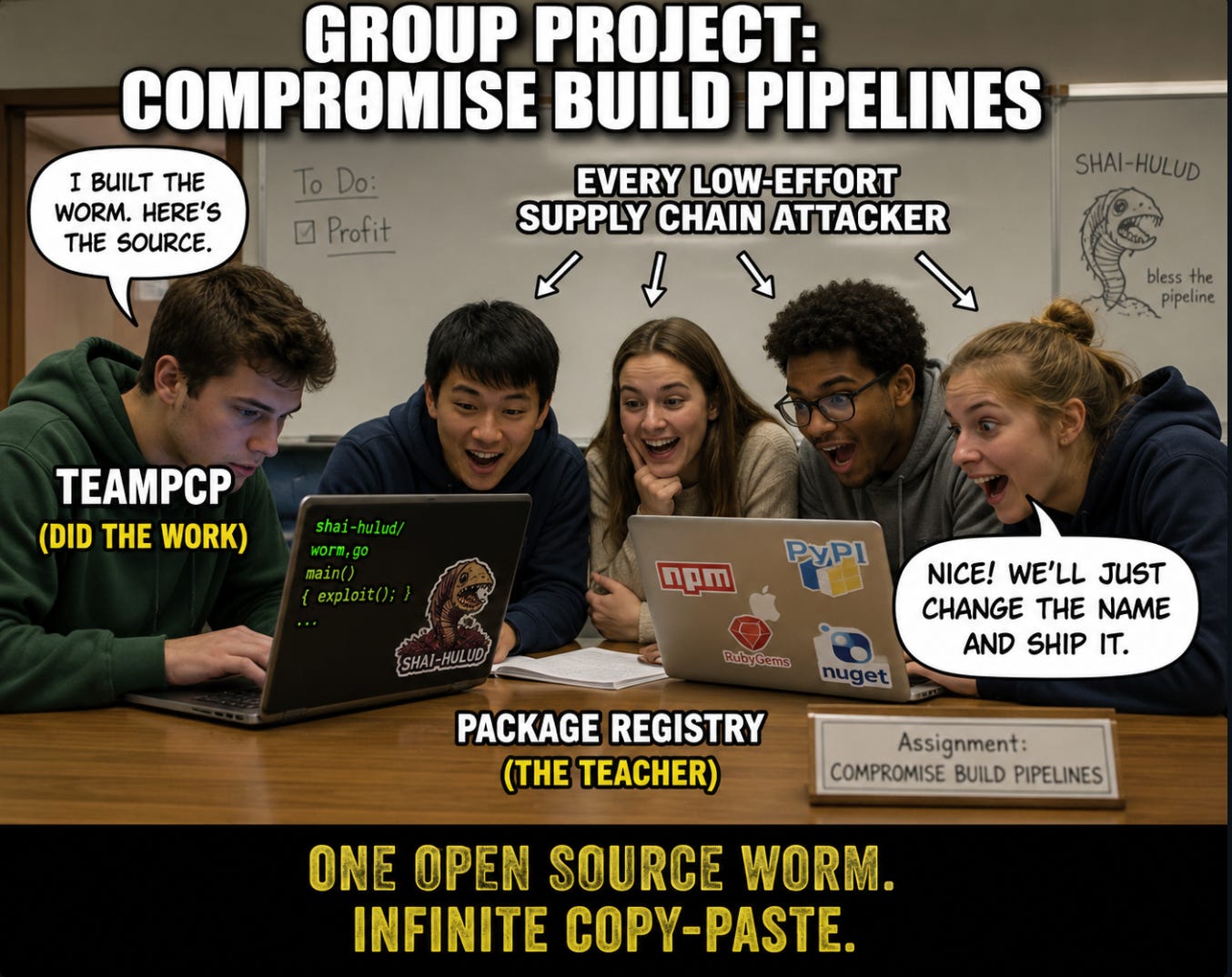
The barrier to entry for supply chain attacks just dropped to "can you clone a repo and change a variable name." TeamPCP did the engineering. The registries do the distribution. Your build pipeline does the rest.
ROLE-BASED TAKEAWAYS
Executive / CISO / Board Level
SD-WAN management plane risk requires board-level visibility. Six exploited zero-days in one product family in five months is not a normal patch cycle. Request a briefing on whether your SD-WAN controllers are reachable from any segment other than a dedicated management network. If the answer is yes, that is a material risk.
Third-party manufacturing exposure is now a business continuity and data exposure risk. Foxconn’s 8TB exfiltration included customer data, and manufacturing downtime creates pressure that ransomware operators understand well. If your organization relies on contract manufacturers, require network architecture evidence and incident notification timelines, not just compliance attestations.
Open-source supply chain attacks are moving from campaign tracking to technique commoditization. TeamPCP’s release of Shai-Hulud source code means defenders cannot rely on known-bad package names or actor infrastructure alone. Budget for behavioral monitoring of build and dependency pipelines, not just known-bad package scanning.
Enterprise Architect
Design Principle Impact: The assumption that SD-WAN management planes are implicitly trusted because they sit “inside” the network has been invalidated six times this year. Redesign management access to require out-of-band connectivity with explicit authentication that does not depend on the SD-WAN controller’s own auth mechanisms.
New Constraint/Dependency: Open-sourced supply chain attack tooling creates a new constraint meaning build pipelines must now enforce network isolation during dependency installation and compilation. Architect CI/CD environments with egress filtering that blocks all outbound connections during install and build phases.
Architecture Adjustment: Manufacturing partner connectivity should be treated as part of your resilience architecture, not just third-party risk. Segment customer IP, production telemetry, and partner file exchange paths so a supplier ransomware event cannot simultaneously threaten operations and expose sensitive data.
Security Operations
Implementation Watch Item: Monitor Cisco Catalyst SD-WAN Controller logs for new administrative account creation, unexpected configuration changes, route policy changes, tunnel creation, and API authentication events from non-standard source IPs. Any management-plane change without a matching change ticket should be treated as high priority.
Common Failure Mode: Treating the Foxconn incident as only a supplier breach. If your organization depends on a manufacturer, the operational risk is not limited to stolen files. Watch for exposed customer project names, internal identifiers, logistics data, product documentation, or partner credentials appearing in leak sites, dark web listings, or attacker negotiation portals.
Monitoring Patterns: For Kazuar-style modular malware, prioritize behaviors that remain stable when modules change: C2 cadence, process injection patterns, persistence locations, credential access behavior, and unusual file staging activity. Hashes and plugin-specific signatures are useful, but they should not be the center of the hunt.
Signal vs Noise Guidance: Package updates that trigger outbound connections, spawn child processes, access environment variables, or modify workflow files during install should not be treated as normal developer noise. In a post-Shai-Hulud environment, build-time behavior is production-impacting behavior.
Adversarial edge item: Run a controlled “known-bad package install” exercise in a sandboxed CI/CD runner and validate that your pipeline detects the behaviors this week’s threats depend on such as unexpected outbound connections, child process spawning, environment variable access, and workflow file modification. If those actions are invisible in a test, they will be invisible during a real supply chain compromise.
See you next Monday!
The Monday Brief is produced by Douglas McKee and Ismael Valenzuela. The opinions expressed are our own and do not reflect those of our employers.