Suspected State Actors Exploited a Citrix NetScaler Zero-Day for Three Weeks Before Anyone Confirmed the Campaign
Weeks of NetScaler exploitation, Star Blizzard’s scaled phishing, paid insiders, and Microsoft’s warning that attackers are winning the early AI race.

Summary
Mandiant traced the earliest known NetScaler exploitation to September 3, and public disclosure did not arrive until the last week of the month. That gap of more than three weeks is the main story this week. Patching speed matters, but the bigger failure is visibility on an appliance most organizations cannot inspect from the inside.
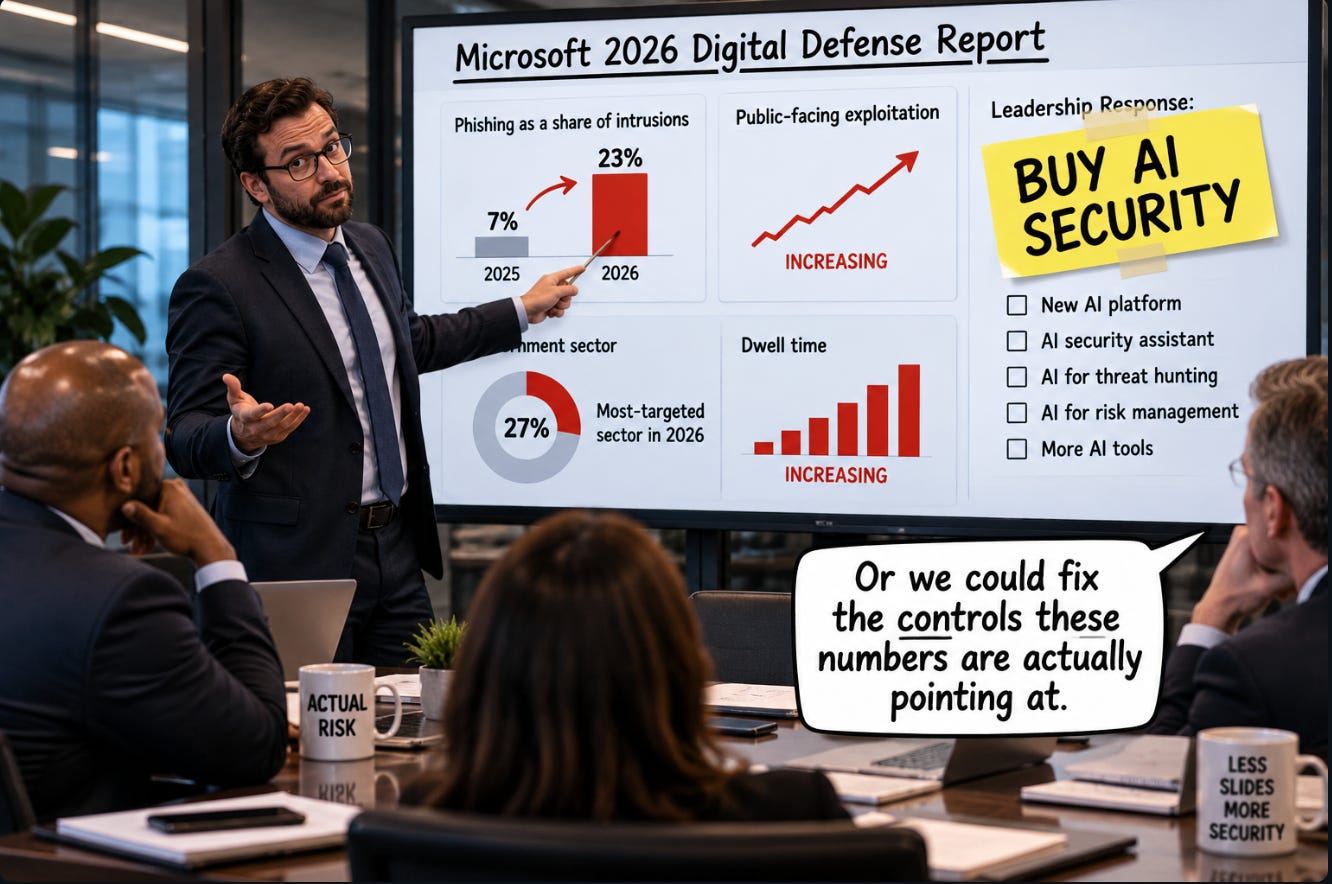
Suspected state-sponsored operators exploited two Citrix NetScaler zero-days against government, financial services, technology, education and legal targets in North America and Europe. Russia’s FSB-linked Star Blizzard added automated mass-mailing campaigns to its bespoke spear-phishing, paired with an infection chain that needs a single user interaction. Intel 471 documented a maturing underground market where criminals pay to recruit employees already on your payroll. Microsoft’s Digital Defense Report put hard numbers behind what defenders already felt: phishing rose from 7 percent of the intrusions its responders investigated in 2025 to 23 percent in 2026, and dwell time grew.
The NetScaler campaign forces you to rethink how long an edge appliance can sit compromised before anyone notices. Volume doesn’t tell you whether a phishing campaign came from a state actor or a commodity crew, which is what Star Blizzard’s shift costs you. The insider-recruitment market moves the question from who breaks in to who already belongs, and the Microsoft figures argue about where detection money goes rather than how much of it there is.
Which of your internet-facing appliances would tell you if it had been compromised three weeks ago?
Get The Monday Brief in your inbox every Monday. Subscribe for free, and share it with someone who’d find it useful.
Thanks for supporting The Monday Brief.
Weekly Signals Analysis
Edge appliance compromise is now measured in weeks of silence, not hours of patch lag. The earliest known NetScaler exploitation dates to September 3, more than three weeks before public disclosure. If your only signal from a gateway is the vendor advisory, your detection clock starts after the attacker's does. Build independent telemetry around these devices, not just on them.
Automation erased the line between targeted and commodity phishing. Star Blizzard, an FSB actor that historically ran bespoke spear-phishing, now sends campaigns of tens to hundreds of messages that Microsoft believes probably come from a mass-mailing platform, paired with a single-click infection flow. The tradecraft that used to mark “nation-state” is now cheap and scaled, so attribution-by-sophistication no longer tells you who you are fighting.
Your insider risk is now a purchasable service. Intel 471’s report describes brokers paying referrers to find employees who will run a lookup, reset an account, or approve a transaction. This is not the disgruntled-employee model but instead it is more like procurement.
Attackers are compounding their AI advantage faster than defenders. Microsoft’s 2026 Digital Defense Report is blunt that threat actors are collecting the benefits of AI first. Phishing tripled as a share of intrusions and dwell time rose. The fundamentals still work, but the speed changed.
What not to over-index on: AI as the organizing story of the week. The first three signals do not establish AI involvement. Microsoft’s report describes both the acceleration of familiar attacks and additional risks around AI systems. Keep the response tied to the attack paths and exposures the evidence actually supports.
This Week’s Signals
Signal 1: Suspected State Actors Exploited a Citrix NetScaler Zero-Day for Three Weeks Before Confirmation
Why it matters: Citrix confirmed active exploitation of two critical NetScaler vulnerabilities, CVE-2026-88771 and CVE-2026-88772. Mandiant traced exploitation of CVE-2026-88772 to September 3, weeks before public confirmation, with organizations across North America and Europe affected. That is weeks of pre-disclosure activity on a device that often fronts remote access for the whole organization. However, it does not establish the same timeline for the second vulnerability or a uniform dwell time across victims.
What is being misread: Patching speed matters, but this campaign also exposes a visibility problem. Edge appliances often sit outside endpoint monitoring, and important system and web server logs may never reach the SIEM. A compromised appliance can also alter its own evidence. Defenders need to collect the available telemetry, preserve it off the device, and correlate it with network and identity activity.
Think Red (Douglas McKee): I pick the gateway because it’s the entry point into the network and as a bonus the gateway guarantees quiet. Everyone watches the endpoints behind it and almost nobody watches the box itself, so three weeks of dwell time is not luck, it is the design working the way I expect. The appliance already terminates every remote session you have, which means I inherit the trust the whole organization places in it without touching a single workstation. The part worth your attention is not the two CVEs. It is that the device sees all your traffic and reports almost none of it back to you in a form you can hunt in.
Act Blue (Ismael Valenzuela): Patch affected NetScaler deployments now, and investigate for compromise that predates the update. If you find evidence of intrusion, preserve forensic state, isolate the affected appliances, and remove attacker persistence before returning them to service. A patch closes the vulnerability; it does not establish that the backdoors are gone. Coordinate credential and key rotation with that recovery, and explicitly invalidate existing sessions. Check both nodes in high-availability pairs. For detection, verify which appliance logs actually reach your SIEM, including system and web server logs that standard forwarding may miss, and correlate them with network and identity activity. Hunt beyond the gateway for credential theft and lateral movement. Conditional access and device compliance remain useful controls, but neither proves that a compromised appliance or stolen session has been contained.
Supporting sources:
CyberScoop: Attackers exploited the NetScaler zero-day undetected for at least three weeks
Unit 42: Threat brief on CVE-2026-88771 and CVE-2026-88772 exploited in the wild
Cybersecurity Dive: Exploitation began days before public notification
Rapid Risk Radar: CVE-2026-88771
Signal 2: Russia’s Star Blizzard Added Automated Mass Campaigns to Its Bespoke Spear-Phishing
Why it matters: Microsoft documented the FSB-affiliated group Star Blizzard expanding beyond small, highly targeted spear-phishing into mass-mailing campaigns of tens to hundreds of messages, affecting over 100 organizations primarily in the US and UK. A new delivery technique Microsoft calls RedFlick reduces the compromise to a single user interaction before the CosmicPulse backdoor lands.
What is being misread: Many defenders still separate their threat models into “nation-state spear-phishing” and “commodity mass phishing,” and allocate scrutiny accordingly. Star Blizzard just collapsed that distinction, meaning the assumption that volume signals low sophistication, and that a targeted-looking lure signals a serious actor, is now a liability that an FSB operator is actively exploiting.
Think Red (Douglas McKee): Your team sorts inbound phishing by how targeted it looks, and I am about to use that habit against you. A mass-mailing platform lets me run hundreds of lures at the cost that used to buy me one carefully crafted message, and RedFlick trims the victim’s work down to a single click. There is nothing novel about automating phishing, and we have seen it for years, even before AI. The part that pays is that scale now buys me the same compromise my old bespoke operation did, without the time cost. The old tell, that nation-state actors send a handful of surgical emails, is exactly the expectation I want your filters calibrated around.
Act Blue (Ismael Valenzuela): Sophistication and volume are not necessarily correlated, and any triage model that assumes they are can misroute the FSB's traffic into the low-priority bucket. Treat a high-volume campaign and a precision lure as the same severity until the payload tells you otherwise. RedFlick ends with a backdoor on the endpoint, so ensure the decisive protection controls sit there. Restrict execution of the file types and script hosts the lure chain abuses. Alert on scheduled-task creation spawned by user-launched processes, which is how RedFlick stages CosmicPulse. Hunt for CosmicPulse beaconing at the network tier, where the implant cannot hide behind a trusted inbox. Keep phishing-resistant MFA, FIDO2 or hardware keys, on the roles Star Blizzard favors: Ukraine policy, NGO coordination and government relations. Its credential-phishing operations have not gone away, but do not mistake MFA for the control that stops this chain. The volume is the disguise now, not the giveaway.
Supporting sources:
CyberScoop: Star Blizzard expands targeting and changes tactics to reach Ukraine and beyond
Microsoft: Star Blizzard refines phishing and malware delivery with the RedFlick technique
Dark Reading: Russia’s Star Blizzard ditches ClickFix to widen its phishing net
Signal 3: Criminal Groups Are Now Recruiting Your Employees as a Paid Service
Why it matters: Intel 471’s research describes a maturing underground market where criminals pay brokers and referrers to find employees at specific target organizations. Routine actions, information lookups, account resets, transaction approvals, shipment changes, are all being sold as services. Legitimate access lets attackers bypass controls that would be hard to defeat from outside.
What is being misread: Insider threat programs are built around the disgruntled or departing employee, modeling motive and tenure as the risk signal. This market inverts that. The insider may be a well-regarded, long-tenured employee performing their exact job function, just at an attacker’s direction. Controls tuned to catch anomalous people miss normal people performing normal actions for abnormal reasons.
Think Red (Douglas McKee): A help-desk agent who will reset the account I name for a fee puts me inside, and from your side that reset looks exactly like the two hundred legitimate ones before it. Insiders have always been a risk, so I am not claiming anything new about the concept. What makes this worth running at scale is that the action I am buying is indistinguishable from the employee’s normal workday, which means your behavioral baselines are actively vouching for me. The recruiting is the hard part, and brokers have turned that into a commodity. This is the same issue we see with AI agents taking actions that look like legitimate users using user accounts.
Act Blue (Ismael Valenzuela): The malicious action and the legitimate one are the same action here, so detection has to live in approvals. Require multi-party authorization for the specific operations this market trades in, high-value resets, transaction approvals, and shipment or payout changes, so no single insider can complete them alone. We have pushed least privilege and access reviews before, after the Teams IT-support campaign a month ago, and the difference here is that the actor is not impersonating your staff, they are your staff, so the control that matters is separation of duties, not identity verification. Monitor for employees performing sensitive actions outside their usual scope or on behalf of accounts they rarely touch. Pair that with volume-based DLP that fires regardless of the user’s seniority or record. A trusted employee is still a trust boundary.
Supporting sources:
Help Net Security: Criminal recruiters want people on your payroll (Intel 471 report)
Intel 471: Insiders for Hire: What the Underground Market for Employee Access Tells Us About Insider Risk
Signal 4: Microsoft’s 2026 Report Says Attackers Are Winning the Early AI Race
Why it matters: Microsoft’s 2026 Digital Defense Report, covering July 2025 to June 2026, concludes that threat actors are extracting value from AI faster than defenders, accelerating vulnerability discovery, malware development, and post-compromise activity. Concretely, phishing rose from 7 percent of observed intrusions in 2025 to 23 percent in 2026, government became the most-targeted sector at 27 percent of activity, and dwell time increased across multiple sectors.
What is being misread: The headline is being read as “AI changes everything.” The report’s own data says the opposite about fundamentals. The security basics still work, but the speed and scale changed. The misread is treating this as a call to buy AI defense tooling, when the measurable shifts, more phishing, longer dwell time, identity as the entry point, are failures of visibility and identity hygiene that predate AI and are now simply being exercised faster.
Think Red (Douglas McKee): Nothing in my toolkit this year is new to your playbook. What changed is how many times I can run it, because a tool that triples my usable lures and shortens the trip from bug to working exploit lets me do the same familiar things faster than your response cycle absorbs them. The number that should bother you is dwell time going up, because it says that even as you got quicker at kicking me out once you found me, I got better at staying unseen. Speed is the whole advantage here. The techniques are boring and that is exactly why they keep working.
Act Blue (Ismael Valenzuela): As I teach in SEC530, AI accelerates the attack chain, but it does not eliminate our opportunities to break it. Time-Based Security still applies: protection must hold long enough for detection and response to work. That architectural thinking also runs through my recent The Agentic SOC presentation, where trust boundaries and verification matter more than ever. Microsoft’s finding that dwell time increased across multiple sectors should put your detection and response times under scrutiny. Enforce phishing-resistant MFA, tighten privileged access, and segment critical systems to limit what one compromised identity can reach. Verify that you can revoke sessions quickly. Connect appliance, endpoint, network, and identity telemetry, and pre-authorize containment so an analyst can act before the attacker moves further. Evaluate AI tooling against those outcomes: does it help you detect earlier and respond faster? Test those assumptions in your own environment. The advantage of defending your own terrain only counts if your controls work when challenged.
Supporting sources:
Help Net Security: AI is giving attackers a head start, Microsoft warns
BleepingComputer: Microsoft says threat actors are ahead in the early AI race
Microsoft: Preparing governments for an era of interconnected cyber risk
Role-Based Takeaways
Executive / CISO / Board Level
Edge appliance exposure is now a board-level detection question, not an IT patching line item. The earliest known NetScaler exploitation preceded public disclosure by more than three weeks, on devices that often front remote access for the whole organization. Ask your security team one question directly, how would we know if an internet-facing appliance was compromised three weeks ago, and fund the independent telemetry if the honest answer is "we wouldn't."
Insider risk has shifted from an HR problem to a procurement one. Criminals now pay brokers to recruit your employees for routine actions that bypass your external controls. Direct your team to implement multi-party approval for high-value resets, payouts, and account changes, so that no single trusted employee can complete the operations this market is selling.
Measure security investment by how quickly you can interrupt an attack. Microsoft reports longer dwell times despite faster responses after discovery. Fund visibility, hunting capacity, and pre-authorized containment, alongside architecture that limits attacker movement. Judge AI tools by whether they help your team detect earlier and contain faster, and validate those gains through exercises in your own environment.
Enterprise Architect
Design Principle Impact: Design edge-appliance monitoring around evidence the appliance cannot erase on its own. Forward relevant logs to protected storage and correlate them with independent network and identity telemetry. Appliance-generated evidence remains useful, but it should not be your only basis for deciding whether the device is trustworthy.
New Constraint/Dependency: Separation of duties must now be enforced in the application and workflow layer, not just RBAC. The insider-recruitment market means sensitive operations need multi-party completion designed into the process, because a single authorized identity can no longer be treated as a sufficient control for irreversible or high-value actions.
Security Operations
Implementation Watch Item: Authentication and lateral-movement activity originating from or behind NetScaler appliances, specifically sessions and credential use that predate your patch application date.
Common Failure Mode: Treating the NetScaler patch as complete remediation and closing the ticket. Exploitation began before public disclosure, so investigate for earlier compromise and established persistence. A clean post-patch scan does not establish that the attacker is gone.
Monitoring Patterns: Scheduled-task creation consistent with Star Blizzard’s RedFlick staging, CosmicPulse beaconing at the network tier, and employees performing sensitive resets or approvals outside their normal scope or on accounts they rarely touch.
Signal vs Noise Guidance: A help-desk reset is routine. The genuine indicator is a reset performed by an employee for an account outside their normal support queue, or a sensitive approval completed by someone with no prior history touching that transaction type. Volume and role deviation, not the action itself, separate signal from noise.
Adversarial edge item: Pre-authorize containment for NetScaler and other edge appliances. Define the evidence that triggers isolation, preserve forensic state where feasible, and plan for service continuity so a high-confidence compromise does not sit unresolved while teams negotiate approval.
See you next Monday!
The Monday Brief is produced by Douglas McKee and Ismael Valenzuela. The opinions expressed are our own and do not reflect those of our employers.
Discussion about this post