The FBI Says Attackers Can Now Lock Defenders Out of Their Own Firewalls
FortiBleed is still active months later. DOJ and FBI seized Flax Typhoon’s tooling, OpenAI exposed Russia- and Iran-origin fake newsrooms, and a botnet hides its C2 in a GitHub poem.

Summary
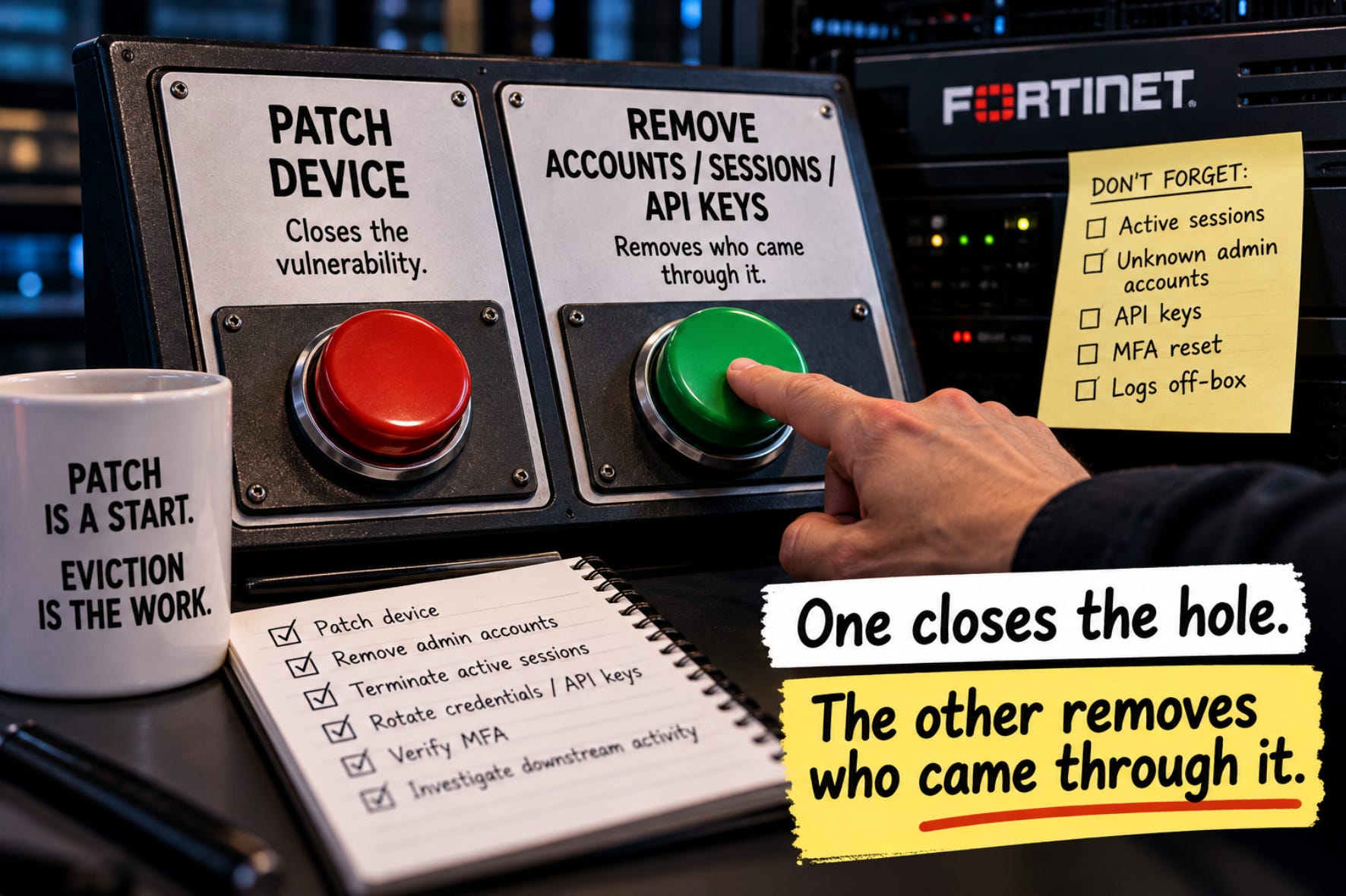
FortiBleed stopped being a vulnerability story months ago. The FBI and Secret Service warned this week that attackers who harvested Fortinet credentials earlier in the year are still using them, creating admin accounts and in some cases disabling the legitimate owners of the firewall so they cannot log back in. Patching and password resets do not evict someone who already owns your identity plane.
Three other stories sat alongside it. The DOJ and FBI seized tooling a sanctioned Chinese firm built for Flax Typhoon, OpenAI exposed two fake-newsroom operations, one staffed well enough to fool its own employees, and Lumen found a botnet reading its command-and-control address out of a poem on GitHub.
FortiBleed forces a question about whether patching is even the main problem anymore, and the Flax Typhoon takedown lands on whoever owns third-party exposure. The influence operations put your communications team in the position of verifying a byline, and PoeLLM rewrites what a C2 indicator looks like.
If you run internet-facing Fortinet gear, are you sure everyone logged into it is supposed to be there?
Get The Monday Brief in your inbox every Monday. Subscribe for free, and share it with someone who’d find it useful.
Thanks for supporting The Monday Brief.
Weekly Signals Analysis
A patched edge device is not a cleaned edge device. FortiBleed shows credential theft that survives the fix. Attackers are using credentials stolen earlier this year to create new admin accounts, and a patch does not remove them. Hunt for unexplained admin account creation and configuration changes on Fortinet gear, not just confirm you applied the update.
State-linked tooling now runs through sanctioned commercial fronts, not just government infrastructure. The Flax Typhoon takedown seized tools built and operated by Integrity Technology Group, a sanctioned private firm. Vendor and supply chain risk reviews that stop at direct suppliers miss the companies quietly enabling nation-state scanning of your perimeter.
Influence operations have crossed from obvious bot spam into credible, staffed personas. OpenAI’s Russian “Dark Clark” network ran a front think tank so convincing its own Latin American staff did not know they worked for a Russian group. Your brand monitoring may be tuned for impersonation, not for legitimate-looking outlets citing fabricated experts.
Indicators of compromise have no context by themselves. PoeLLM derives its C2 address from four words in a poem, resolvable only with the malware in hand. Many of these C2s were never flagged by crowd-sourced reputation tooling at all. Netflow and outbound connection anomalies become your detection, not IP blocklists.
What not to over-index on: standard password rotation as a complete FortiBleed response. The advisory asks for resets alongside account audits, log review and restricted external management access, and the reason the whole list matters is that a reset does not remove an admin account an attacker already created. Rotation without eviction just tells the adversary you noticed and starts a game of cat and mouse; guess who’s the mouse.
This Week’s Signals
Signal 1: FortiBleed Became a Persistence Campaign That Patching Cannot Close
Why it matters: The FBI and Secret Service confirmed FortiBleed is still active, with attackers holding stolen Fortinet credentials from months ago and using them to create admin accounts, potentially move laterally, and hand access to ransomware affiliates including INC/Lynx and Payload. More than 86,644 devices have been confirmed compromised, and later investigation points to 400,000 or more firewalls targeted by the wider operation.
What is being misread: Teams treat this as a Fortinet patch obligation and close the ticket after updating and resetting passwords. The issue is assuming the firewall is the asset under attack. The credentials are, and once an attacker holds valid admin identity, the device is just the door they already walked through. The newly disclosed lockout capability means the real owner can be the one excluded.
Think Red (Douglas McKee): Your patch cycle is working against you here, not against me. The credentials came out months ago, so by the time your advisory lands I have admin accounts that look like I belong here. From a red-team seat, the gift here is the lockout. I can disable your accounts or change your passwords, which means while you are scrambling to reset I am still logged in on a session you cannot touch. The device patch does nothing about the identity I already minted. If you want to find me, stop looking at firmware versions and start asking which admin accounts nobody remembers creating.
Act Blue (Ismael Valenzuela): A credential-theft campaign that outlives the patch is an identity incident wearing a vulnerability costume. Patch and reset, yes, but treat those as table stakes rather than closure. Pull every administrative account on your Fortinet appliances and reconcile it against your change records. Any admin you cannot tie to an approved ticket is a lead that needs to be followed. We flagged credential rotation after the NetScaler disclosure last week, and the sharper point this time is that rotation alone can be worse than nothing, because it signals the adversary without evicting them. In my years as an incident responder, I have seen careless responders tip off motivated attackers who were still on the network. What followed was a chase that sometimes ended with the attacker wiping their traces, going dormant until the victim believed the incident was closed, or in some cases retaliating with destructive attacks. Enumerate active sessions, force full re-authentication from a known-clean state, and hunt Active Directory, Entra ID, and any other identity provider for new accounts and the lateral movement the FBI warns may follow this access. Isolate management interfaces so a stolen firewall credential cannot reach your identity plane unchallenged. The credential decides who is inside. The patch only decides who gets in next.
Supporting sources:
CyberScoop: FBI and Secret Service warn FortiBleed remains active and leads to ransomware
CSO Online: FortiBleed attackers can lock organizations out of their own firewalls
Signal 2: The DOJ and FBI Seized Flax Typhoon’s Tooling, Built and Run by a Sanctioned Chinese Firm
Why it matters: The DOJ and FBI seized seven domains supporting MicroScan and FishHub, the vulnerability scanning and spearphishing tools that Flax Typhoon used to breach critical infrastructure worldwide, with CISA setting an October 11 deadline for federal agencies to address five associated flaws. The operator was not a government unit directly but Integrity Technology Group, a sanctioned Beijing firm, and the FBI revealed the hackers ran a portal letting third parties access stolen emails.
What is being misread: Coverage frames this as another China APT takedown, which undersells the structural detail. The scanning and intrusion capability sat inside a commercial company, and the advisory describes a portal that gave unnamed third parties access to stolen email. The assumption that nation-state tooling lives on government infrastructure you can map geopolitically breaks when the capability is a product sold by a firm, and the exploited flaws include CVE-2015-3306, a decade-old ProFTPD bug.
Think Red (Douglas McKee): A ten-year-old ProFTPD flaw still answering on your perimeter is the part that should be embarrassing. Ill say it again, no zero-day required, and I especially do not need to build scanning infrastructure if a company will sell it to me as a service. What stands out is the portal. Someone did the breaching, then packaged the stolen email for buyers, which means the intrusion and the monetization were cleanly separated. That separation is what makes a takedown slower than it should be, because seizing the tools does not unwind every environment already compromised through decade-old bugs nobody prioritized. The seizure is a disruption, not an eviction, and the access that was already sold is still live.
Act Blue (Ismael Valenzuela): Nation-state capability delivered as a commercial product changes how third-party risk should read. The firm enabling the scanning of your perimeter may never appear in your vendor list, because it is your adversary’s supplier, not yours. Check the five CISA KEV additions now, and note that CVE-2015-3306 is a 2015 flaw, so this is as much an asset-inventory failure as a patching one. Find the forgotten internet-facing services running software you stopped tracking years ago. The takedown degrades the infrastructure, it does not clean the environments already breached, so assume compromise where you ran exposed legacy services and hunt for the exfiltration that FishHub-style phishing and MicroScan enumeration enable. Visibility that spans the enterprise and the operational side together is what turns a government advisory into an actual detection. A disrupted tool is not a closed intrusion.
Supporting sources:
CyberScoop: DOJ, FBI seize Flax Typhoon tools MicroScan and FishHub
The Record: International coalition seizes tools behind Flax Typhoon
CISA/FBI/NSA joint advisory AA26-281A: China-based cybersecurity company enabling threat actors
CISA Known Exploited Vulnerabilities Catalog
Signal 3: Russian and Iranian Operators Ran Credible Fake Newsrooms, Not Just Bot Spam
Why it matters: OpenAI disrupted two influence operations using ChatGPT, one Russian cluster called “Dark Clark” and one Iranian that OpenAI says looked consistent with a commercial for-hire operator rather than the state. Both built fake journalist personas. The Russian group ran the Social Research Center, a fabricated Latin American think tank whose own local staff did not know they were working for a Russian operation, while the Iranian personas got roughly 100 articles published or syndicated across about a dozen outlets.
What is being misread: The reflex is to file this under disinformation and move on, which treats it as a trust-and-safety problem for the platforms. The operational detail that matters is the quality threshold. These were not low-effort botnets. The Russian front fooled its own employees and drew fact-checks and official government denials, and the Iranian personas placed roughly 100 articles across about a dozen small and medium-sized publications. The assumption that impersonation detection and obvious-bot filtering protect your brand breaks when the propaganda arrives through a legitimate-looking outlet citing a fabricated but professional expert.
Think Red (Douglas McKee): Your detection is built to catch impersonation, and I am not impersonating anyone. I am building a credible person who does not exist, giving her a think tank, and letting your own trusted outlets launder the message for me. From an offensive influence seat, the leverage is that the humans in the loop become unwitting distribution. The Latin American staff thought they had a real employer, and the editors thought they had a real source. Neither one was lying to you, which is exactly why your fakery filters never fire. The win is not volume. It is credibility borrowed from institutions you already trust.
Act Blue (Ismael Valenzuela): Influence operations at this quality grade are a brand and executive risk, not just a platform moderation story, and they belong in the threat model of whoever owns your communications. The practical move is verification discipline. When a new outlet, analyst, or think tank cites your organization or your sector, confirm the people and the institution exist independently before anyone engages or amplifies. Build a short provenance check into the comms workflow the same way you built phishing checks into email. Platform takedowns remove specific accounts, they do not remove the next persona, so treat detection as continuous rather than incident-driven. Monitor for fabricated experts and front organizations referencing your industry, and route anything suspicious to a named owner. Credibility is the payload here. Verify the source before the source becomes your problem.
Supporting sources:
CyberScoop: OpenAI says Russia, Iran used AI journalists and think tanks to influence Western media
The Record: OpenAI says it disrupted Russian and Iranian influence ops that used ChatGPT
Signal 4: PoeLLM Hides Its Command-and-Control Address Inside a Poem
Why it matters: Lumen’s Black Lotus Labs detailed PoeLLM, malware that has compromised more than 3,400 servers since April by targeting open-source AI services, and derives its command-and-control address from four specific words in a poem posted to a public GitHub repository. The words have been changed at least a dozen times, and the C2 address is invisible outside the victim’s own netflow.
What is being misread: This gets read as a clever trick, which misses what it does to detection economics. A threat intelligence program that depends on blocklists, domain reputation, and signature feeds assumes malicious infrastructure is externally observable. PoeLLM breaks that assumption. The poem has no links, no payload, and no encrypted strings, so nothing flags it, and the C2 only resolves if you already hold the malware and its dictionary.
Think Red (Douglas McKee): The session is quiet and your indicator feeds are blind, because there is nothing to feed them. I have hidden the one artifact you could block inside a poem that any analyst would scroll past, and I can rotate it whenever I want by editing a few words. There is prior art for dead-drop resolvers and domain generation, so the technique is not new, but the hosting choice is sharp. A benign poem on GitHub carries no reputation signal and no reason to be flagged, even by a model scanning for malice. The only place my C2 shows up is in your own outbound traffic, which is exactly where most teams are not looking closely enough.
Act Blue (Ismael Valenzuela): When the indicator you would normally block lives inside benign-looking content, outbound behavior becomes your detection surface. Reputation and signature feeds will not see a poem on GitHub, so the compromise reveals itself in netflow. Baseline normal egress from your AI and open-source service hosts, then alert on outbound connections to destinations with no corresponding business purpose or service dependency. These servers often run exposed open-source AI tooling, so inventory what you have internet-facing and strip egress that those workloads do not genuinely need. We have made the egress-control point for AI infrastructure before, after the agent incidents, and here it applies to the compromised host rather than the agent itself. Watch for the connection pattern, not the domain. The address will change a dozen more times. The behavior of a server reaching somewhere it never used to will not.
Supporting sources:
Role-Based Takeaways
Executive / CISO / Board Level
Edge device compromise is now an identity problem that outlives remediation. FortiBleed attackers are still inside organizations that patched and reset months ago, and they can lock legitimate admins out of their own firewalls. Direct your security team to report, within the week, how many administrative accounts on internet-facing appliances cannot be matched to an approved change record, and authorize a full re-authentication and account audit rather than a password reset alone.
Nation-state cyber capability is being sold as a commercial service. The Flax Typhoon takedown seized tooling operated by a sanctioned private firm, and the advisory describes a portal giving third parties access to stolen email. Request a review of whether your third-party risk program accounts for exposure through decade-old internet-facing services, and confirm the five flaws CISA added to KEV, which federal agencies had to fix by October 11, are addressed across your perimeter.
Disinformation targeting your brand now arrives through credible fake outlets. Russian and Iranian operators ran fake fronts credible enough to place stories with real editors, and in Russia’s case to deceive its own staff. Establish a policy that your communications team independently verifies the existence of any outlet, analyst, or institution before engaging, and have the board treat influence operations as a named enterprise risk.
Enterprise Architect
Design Principle Impact: Design for compromise. FortiBleed shows a patched appliance can still be fully owned through valid credentials, so assume the edge credential is already in an attacker’s hands. Isolate the management plane so a compromised firewall credential cannot reach the identity plane without independent authentication, and contain the blast radius when it does.
New Constraint/Dependency: Detection can not assume externally observable malicious infrastructure. PoeLLM resolves C2 from rotating content on legitimate platforms, which makes outbound behavioral baselining a hard dependency for any host running internet-facing open-source or AI services, not an optional enhancement.
Security Operations
Implementation Watch Item: Administrative account creation and configuration changes on Fortinet appliances. Reconcile every admin account against change records and flag any you cannot attribute.
Common Failure Mode: Closing the FortiBleed response after patching and password resets. Neither removes an admin account an attacker already created, which is why the advisory pairs resets with account audits and log review.
Monitoring Patterns: Watch for new admin accounts, Active Directory enumeration, and lateral movement following Fortinet access. For PoeLLM-style activity, baseline egress from AI and open-source service hosts and alert on outbound connections with no corresponding service dependency.
Signal vs Noise Guidance: An admin account tied to an approved change ticket is noise. An admin account that matches no record, or an outbound connection from a server to a destination it has never contacted and has no business reason to reach, is a genuine indicator worth immediate escalation.
Adversarial edge item: For FortiBleed specifically, scope before you act and evict all at once. When an unexplained admin account turns up, quietly map every account, session and foothold the attacker holds before touching any of them, then remove them in a single coordinated move. Pre-authorize that eviction, including a forced full re-authentication from a known-clean state, so it can execute the instant scoping is done. This matters most when the attacker has broad access to the environment: removing one account at a time tips them off, and with the lockout capability they can turn your partial response against you before you finish.
In memoriam: Carric Dooley, mentor and friend, who opened doors for so many of us in this industry.
See you next Monday!
The Monday Brief is produced by Douglas McKee and Ismael Valenzuela. The opinions expressed are our own and do not reflect those of our employers.
Discussion about this post